spierce's blog

R/V Wecoma: 27 September 2008, 1258

bigships.jpg

Our expert crew on the Bridge will keep us out of harm's way, avoiding big ships like these.

R/V Wecoma: 27 September 2008, 1258

Navigation display:  Wecoma about to cross shipping lanes

We begin a Columbia River entrance 25-hour time series transect, right across the maw. The southern end of the transect crosses the major shipping lanes feeding into the Columbia. Shown here on our navigation display is the R/V Wecoma about to cross the shipping lanes.

R/V Wecoma: 27 September 2008

screen_touch.jpg

We were so intrigued by the SlowDrop data,
we felt compelled to violate policy and touch the screen!

R/V Wecoma: 27 September 2008

plume_front.jpg

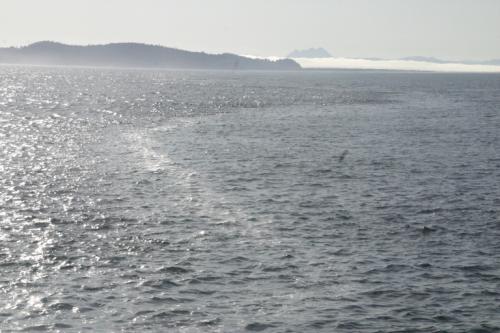
We were able to locate a remarkably sharp plume front (pictured), where fresh water ebbing out of the Columbia meets salt water. We SlowDropped here and found thin layers associated with this front.

R/V Wecoma: 27 September 2008

mission_control.jpg

Chris at SlowDrop mission control station.

R/V Wecoma: 27 September

SlowDrop and Oscar.

Oscar helping to prepare the SlowDrop vertical profiler for deployment.

R/V Wecoma: 26 September 2008

ADCP boom looking lovely in the sunset.

Continuing to survey the plume. All is well with the boom-mounted ADCP.

R/V Wecoma: 26 September 2008, 0945

Chief Engineer Hank Hazen

Crack in ADCP boom has been quickly repaired, welded by Chief Engineer Hank Hazen. He made it look easy, but really this is quite a skill. Thank you Hank!

R/V Wecoma: 26 September 2008, 0800

boom_crack.jpg

We have been surveying the Columbia River plume with CTDs and boom-mounted ADCP.

We were disturbed to find that the steel boom for the ADCP was starting to crack, in fact had almost completely cracked off (see photo). This boom is subject to surprisingly large forces in rough weather.

R/V Wecoma: 25 September 2008, 1045

Satellite-tracked drifter, ready for launch.

Heading out to sea with the argos glider. Timed the crossing of the Columbia River bar at time of slack tidal current. Deployed drifter at 46 11.83 N, 124 14.09 W, a few miles outside of the river mouth.

Events

« December 2008 »
SuMTuWThFSa
123456
78910111213
14151617181920
21222324252627
28293031

User login

Search CMOP

Research Feature

CMOP scientists study plankton blooms in the Columbia River. Read More

Profile

Nirzwan Bandolin is a graduate student studying estuarine turbidity maximum. Read Profile

Outreach

4th IEEE International Conference
CMOP researchers will present on Dec. 11th at the conference in Indiana. Learn More

Director's Welcome

CMOP is an outstanding opportunity to address regional and national priorities in ocean policy, and beyond.
More ...